
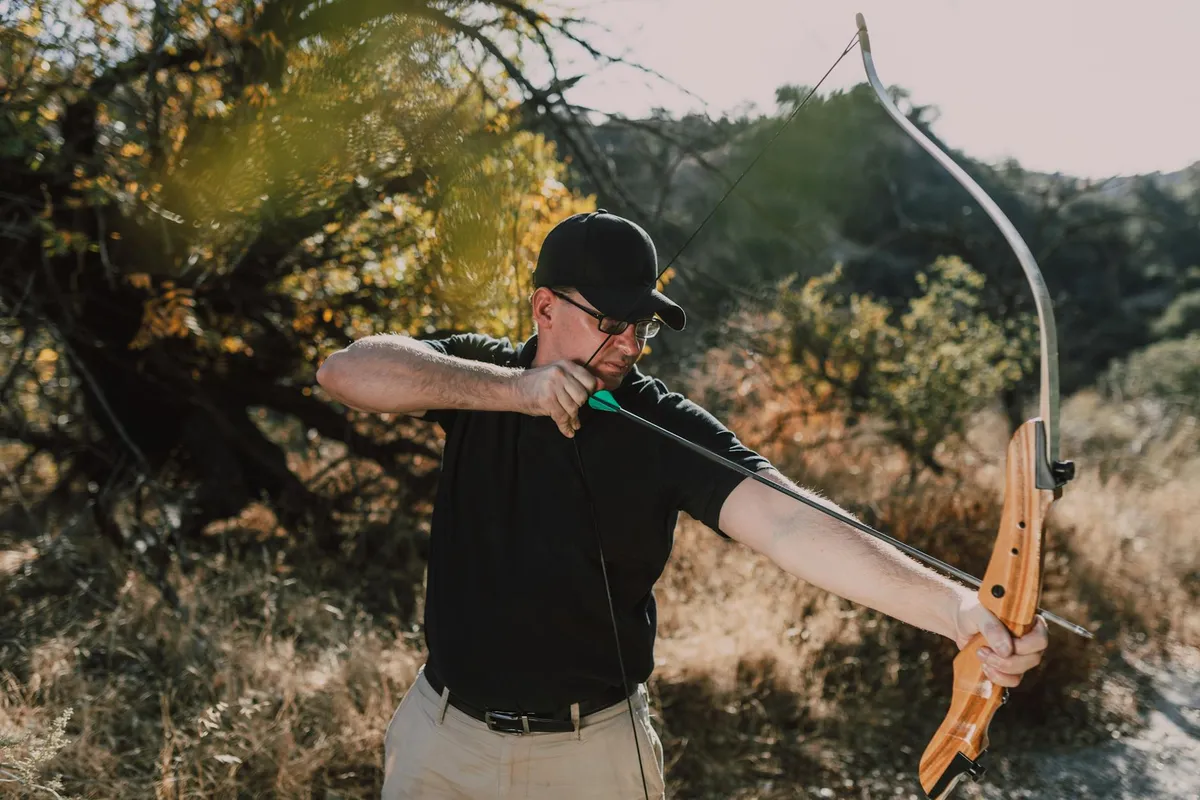
I shot compound bows exclusively from 2017 to 2025. I had a series of nice compounds — Mathews, Hoyt, PSE — all with carbon arrows, mechanical releases, and the scope-and-pin sights that modern compound shooting requires. I was a competent shooter. I could put arrows where I wanted them at 60 meters without much trouble.
This spring I picked up a traditional recurve bow — a Bear Montana 60-inch, 45-pound at 28 inches draw — and committed to six weeks of focused practice with it. I want to talk about what changed in that time, because some of what I learned has stayed with me even after I've gone back to also shooting the compound.
Why I made the switch
The honest answer is that I was bored. The compound bow had become a kind of mechanical exercise. I drew, anchored, aimed through the peep at the pin, released, and the arrow went exactly where the pin was pointing. The skill set was real but it had stopped feeling like a craft. It felt more like operating a tool.
I had read about traditional archery for years and a friend who shoots traditional had been encouraging me to try it. In April I bought the Bear Montana on a whim and committed to six weeks of focused practice — at least four range sessions per week, with no compound work during that period.
Week one: humility
The first week was humbling. At 10 meters, shooting at a 20cm target with no sights and no mechanical release, I was missing the target entirely on roughly one in four shots. My compound-shooter form didn't transfer at all. The draw cycle was completely different. The release with fingers instead of a mechanical aid produced wildly inconsistent results.
I went home from the first session feeling like a beginner. Which, in this discipline, I was. The skill set I had built over eight years of compound shooting had limited transfer to what I was now trying to do.
Week two: form work
Week two I focused on form work. I watched YouTube videos from traditional archery teachers — Tom Clum, Bear Archery, various Olympic-style coaches — and worked on the basics. Draw to a consistent anchor point (mine ended up at the corner of my mouth). Hold steady at full draw. Release cleanly with relaxed fingers. Follow through without dropping the bow arm.
By the end of week two, I was consistently hitting the 20cm target at 10 meters. Groups were still wide — about 30cm spreads — but the misses were now near-misses rather than wild flyers.
Week three: instinctive aiming
Week three I started working on instinctive aiming. This is the traditional archery technique where you don't consciously aim along the arrow shaft; you look at the spot you want to hit and let your subconscious calibrate the angle. It feels strange at first because there's no explicit aiming point.
The technique takes time to develop. By the end of week three, I had started to develop a feel for the bow at 10 and 15 meters. Groups at 10 meters tightened to about 20cm spreads. At 15 meters I was hitting the target reliably but with wider groups.
Week four: increasing distance
Week four I started pushing distance. 20 meters, then 25 meters, then occasional shots at 30. The longer distances exposed every flaw in my form. Any inconsistency in draw length, any tension in the bow arm, any twitch in the release showed up as a clearly missed shot.
I went back to closer-distance form work for half of each session and only pushed distance for the other half. This gave me time to consolidate the form fundamentals while also working on the longer ranges.
Week five: the shift in feel
Week five was when something shifted. The shooting started to feel different. Instead of consciously thinking about each component of the form, the shot was becoming integrated. I would look at the target, draw to anchor, hold momentarily, and release — and the arrow would go where I wanted it to with increasing consistency.
This is the experience that traditional archers talk about and that I had been skeptical of. The bow becomes an extension of the body rather than a separate tool. The aiming becomes intuitive rather than conscious. The shot itself becomes a single integrated action rather than a sequence of separate movements.
Week six: the deeper engagement
By week six, my shooting had reached a basic level of competence. At 15 meters I was consistently hitting a 15cm group. At 20 meters my groups were around 25cm. At 25 meters they were around 35cm. These are not impressive numbers by competitive archery standards, but they represent six weeks of focused work in a discipline I had no prior experience with.
More importantly, the shooting felt different than the compound shooting had felt. It required more from me. The act of releasing the arrow was actually difficult — each shot required actual skill and actual presence of mind. Distractions and mental wandering showed up immediately as missed shots.
What this changed about my relationship to the sport
I went back to also shooting the compound after the six weeks. I haven't abandoned compound shooting; for hunting at longer distances and for the precision that compound enables, it remains useful. But the traditional recurve has become the bow I shoot most.
The reason is that the traditional shooting requires more from me as a shooter, and that requirement makes the shooting itself more interesting. Every shot is uncertain. Every shot is a small act of focused attention. The skill is real and the skill develops slowly, in a way that the compound's mechanical precision tends to mask.
Recommendations for compound shooters considering the switch
If you're a compound shooter thinking about trying traditional, here's what I'd suggest based on my own experience.
Buy a moderate draw weight. I shot 70-pound compounds for years. The 45-pound recurve was hard to shoot well because traditional bows are less efficient and the draw cycle is more demanding. I should have started with 35 or 40 pounds and built up.
Commit to a real practice period. Six weeks of focused work was the minimum needed for the discipline to start clicking. Anything less and I would have given up frustrated. Plan for two months of regular practice before judging whether traditional is for you.
Don't expect the compound form to transfer. It mostly doesn't. Approach the recurve as a new discipline rather than as a variation on the compound. The skill set is genuinely different and the transition requires accepting the beginner's position.
Get instruction if you can. I worked from YouTube and from my friend who shoots traditional. Formal instruction would have accelerated the learning. Local clubs often have traditional archers willing to coach beginners.
The closing observation
I bought the recurve because I was bored with the compound. Six weeks later, I had a discipline I was actually engaged with again. The compound is still in the safe and I still shoot it for specific purposes. But the recurve has become the bow I pick up first, and the reason is that it asks more of me as a shooter.
Whether that trade-off appeals to you depends on what you want from archery. If you want maximum precision and ease of use, the compound is the right tool. If you want a craft that develops slowly over years and that engages your full attention with every shot, the traditional recurve is a different kind of experience. Both are valid. For me, right now, the traditional bow is the one that's interesting.