I keep a range notebook. I started doing this in 2012 and I have a stack of them now — small water-resistant field books with notes from every range session I've done in the last thirteen years. The notebooks are the most useful single thing I've done for my shooting development.
For this article I'm going to share the November pages from this year — what I worked on, what the groups showed, what I learned. The point isn't that my November was particularly impressive; it wasn't. The point is to show what useful range notes look like and to suggest that you should keep something similar if you don't already.
November 3 — first session of the month
Range: Local outdoor 100m range, sunny, +4°C, slight crosswind from the left.
Goal for the session: Re-establish 100m zero with the Tikka T3x in 270 Win after summer storage. Verify cold-bore impact is consistent with the warmed-up group.
Setup: Vortex Viper PST scope, Federal Premium 130gr ammunition, prone with bipod and rear bag.
Cold bore shot: 14mm low, 8mm right of point of aim at 100m. This is within my normal cold-bore variance and doesn't require zero adjustment.
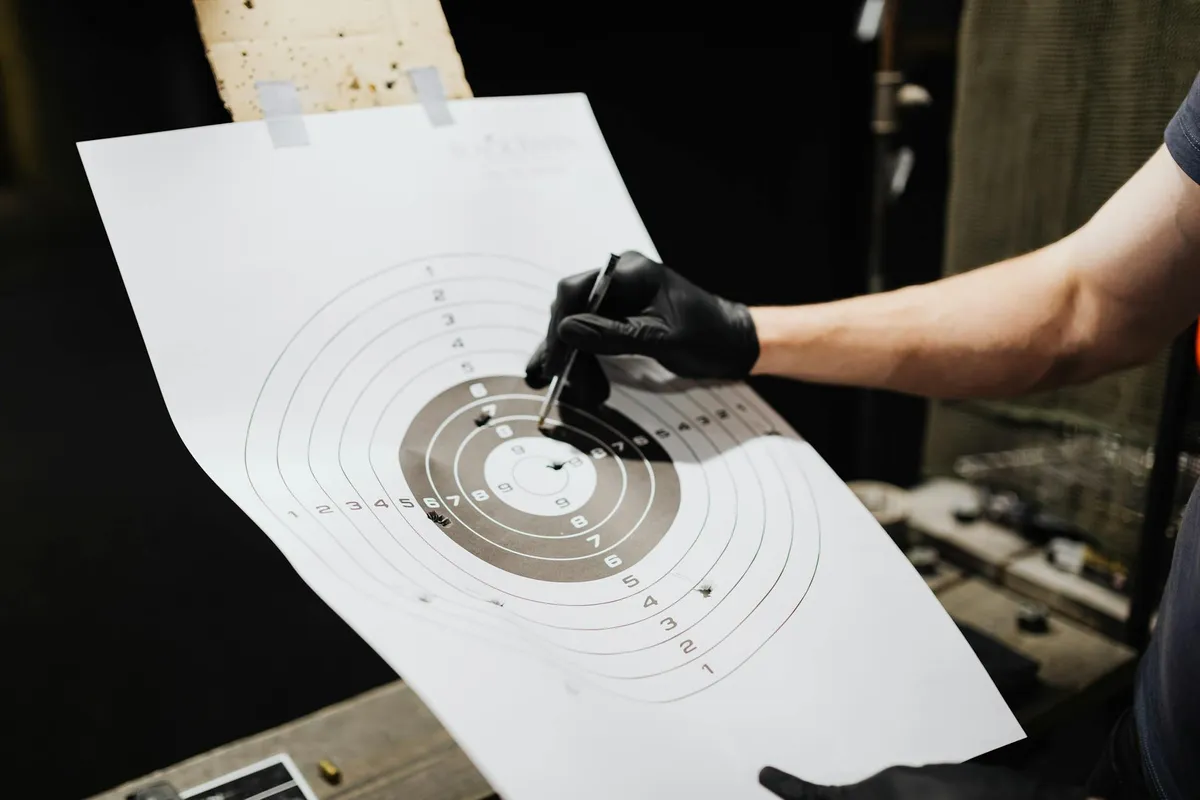
Five-shot group after cold bore: 21mm center to center. Group centered approximately at point of aim. Zero confirmed.
Notes: Bipod felt slightly loose at the rear leg — need to check tension before next session. Trigger pull felt the same as I remembered — no creep, breaks cleanly. Recoil management was a little sloppy on shots 3 and 4 of the group; need to focus more on shoulder pressure into the rifle.
What I learned: The rifle is shooting where I left it. The cold-bore variance is normal. Need to attend to bipod hardware before next session.
November 9 — precision work at distance
Range: Mountain valley range, 100-500m with steel targets. Overcast, +1°C, no wind initially with light wind from the right developing later.
Goal for the session: Work on 400-500m precision with the same Tikka setup. Practice wind reading and adjustment for the lighter Federal ammunition.
Setup: Same as Nov 3. Started prone from bipod, transitioned to bipod-and-bag for the longer ranges.
200m groups (three groups of five): 67mm, 71mm, 89mm. About 1.1-1.5 MOA. Acceptable for the rifle. The 89mm group included one flier from a shot where I felt the trigger break poorly.
300m groups (three groups of five): 138mm, 152mm, 141mm. About 1.5-1.7 MOA. Wind was developing during the third group and the spread reflected my underestimation of the wind correction.
400m: Started with five-shot group at 215mm (1.85 MOA). This is at the edge of acceptable for this rifle. Worked on wind reading for another twenty rounds, with hit rate on a 30cm steel plate around 60%.
500m: Hit rate on the same plate around 35% across twelve attempts. Misses were primarily horizontal — wind reading errors.
What I learned: My wind reading at 400m+ needs substantial work. The rifle is capable of better hits than I'm producing because I'm missing the wind. Need to focus on wind reading specifically in the next sessions. The fundamentals of position and trigger work are holding up; the limiting factor is currently wind judgment.
November 16 — dry fire and form work
Range: At home, snap caps, indoor.
Goal for the session: Pure form work. No live fire. Focus on trigger press isolation and position consistency.
Setup: Same rifle and scope, snap cap loaded, dry firing from prone position on the living room floor with a target taped to the wall at simulated 25m.
Drills: 30 dry-fire repetitions focused entirely on trigger press without any movement of the reticle. Each one slow, with full attention to the trigger break.
What I noticed: My trigger press was producing slight scope movement on roughly one in four reps. The movement was small — a few mils at the simulated distance — but it was there. The issue was finger placement on the trigger; I was occasionally pressing slightly to the side rather than straight back.
What I learned: Even after thirteen years of shooting, fundamental trigger press needs continued attention. Dry fire is undervalued. I should be doing more of it. Twenty minutes of focused dry fire in the evening is at least as valuable as some range sessions.
November 22 — competition simulation
Range: Local outdoor with movable target stands.
Goal for the session: Simulate competition conditions — time pressure, position transitions, multiple targets at varied distances. Test how my groups hold up under stress.
Setup: Same rifle setup. Stage designed by me — five steel plates at 100-300m, three positions (prone, kneeling, standing-with-tripod), 90 seconds total to engage all five plates from any combination of positions.
First run: 4 of 5 hits in 87 seconds. Missed the 300m plate from kneeling — couldn't stabilize sufficiently for the precision required at that distance from that position.
Second run: 3 of 5 hits in 94 seconds (penalty for over-time). Lost time on position transitions. The kneeling-to-standing transition was clumsy.
Third run: 5 of 5 hits in 82 seconds. Better position management, faster transitions, all hits clean.
Fourth run: 4 of 5 hits in 79 seconds. Missed the 200m plate from standing — couldn't stabilize on the tripod quickly enough.
What I learned: My pure precision is better than my speed-precision. When time pressure is added, I lose accuracy. The fix is more repetition of positional shooting under time pressure. Need to add this to my regular training.
November 28 — final session of the month
Range: 100m outdoor, cold (-3°C), light snow.
Goal for the session: Test cold-weather function and verify cold-bore impact in winter conditions.
Setup: Same rifle. I waited 10 minutes after arrival to let the rifle equilibrate to the cold temperature before firing.
Cold bore: 11mm low, 4mm left of point of aim. Slightly lower than typical but within variance.
Five-shot group: 28mm. Slightly wider than warm-weather groups but acceptable for winter.
Function: No issues. Bolt manipulation slower in the cold with gloves but no malfunctions. Trigger break was the same as warm-weather sessions.
What I learned: The rifle handles cold acceptably. Practice with gloves on is meaningfully different from practice without — slower manipulation, slightly different trigger feel through glove fabric. Need to practice more with gloves before winter hunting.
The summary for the month
Total rounds: 187 (down from October's 230 — limited by weather).
Sessions: 5 plus one dry-fire session.
Notable progress: Better understanding of where my distance shooting fails (wind reading). Better stress shooting under time pressure (third and fourth runs of the competition simulation).
Notable failures: Still missing wind calls beyond 300m. Position transitions need work. Cold-weather glove practice is underdone.
Plan for December: More wind-reading practice with specific drills designed to test small wind calls at distance. More positional work with time pressure. More glove-on shooting before the hunting season.
Why this matters
If you don't keep range notes, you probably don't know what your shooting actually looks like across sessions. Memory rounds the failures down and the successes up. The notebook is honest in a way that memory isn't.
The other reason to keep notes is that they let you see patterns. The wind-reading weakness I identified in November isn't new. If I look at September and October notes, the same weakness shows up. Without the notes I might have missed the pattern; with them, I can plan training that specifically addresses the recurring weakness.
Get a small notebook. After every range session, write down what you worked on, what the groups showed, and what you learned. After a year you'll have a record of your actual shooting that's more useful than any internet content you can read. Including this article.